
|
|


|
Let's Talk Turkey
Frequently asked questions
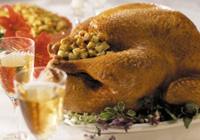
What size bird should I buy?
It depends on how many people you will be serving, and how big a bird your oven can hold. A larger turkey is more efficient at producing meat. For instance, turkeys weighing less than 12 pounds will serve 1 person for each pound of weight. A 10-pound bird will serve 10 people. But a turkey weighing more than 12 pounds will feed 1 guest for each 3/4 pound of turkey weight. So, if you're having 20 guests, you'll only need a 15-pound bird.
What's the best way to thaw a turkey?
The easiest and safest way to thaw a turkey is to place the wrapped bird on a tray in the refrigerator. Plan about 24 hours for each 5 pounds of the bird's weight. Remember not to count the day you will be roasting it. Turkey should never be thawed at room temperature.
I need my turkey today, and it's not completely thawed. What can I do?
Place the plastic wrapped turkey, breast side down, in a sink of cold water. Change the water every 30 minutes.
Once my turkey is completely thawed, how long can I keep it in the refrigerator?
A thawed whole turkey will keep in the refrigerator for 1 to 2 days.
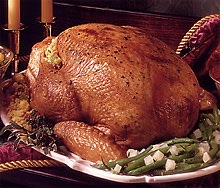
How can I get a beautiful golden brown turkey without drying out the breast meat?
Tent the turkey loosely with foil to delay browning of the breast. The foil should be removed during the last 30 to 45 minutes to allow the turkey to brown. Tenting for the entire roasting time can actually slow cooking.
Do I need to baste a turkey while it's cooking?
Our Test Kitchen doesn't feel that basting today's turkeys is necessary. More importantly, basting tools, such as brushes and bulb basters, could actually be sources of bacteria contamination if dipped into uncooked or undercooked poultry juices, then allowed to sit at room temperature and used later for basting.
How do I know when my turkey is really done? Can I trust the pop-up timer?
Temperature should be your guide to doneness. You can use the pop-up timer as an aid, but to assure that the turkey reaches a safe temperature, always use a thermometer.The thermometer should be inserted into the thickest portion but be sure it does not touch bone or the pan. Use either a meat thermometer which can be inserted at the beginning of the cooking time or an instant-read thermometer. Instant read thermometers are not designed to stay in food during cooking. Pull the food out of the oven, then insert thermometer into the thickest portion of the inner thigh muscle. Wait about 15 seconds before reading.
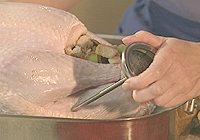
How can I be sure my thermometer is accurate?
Submerge 2 inches of the thermometer stem in boiling water. It should read 212 degrees F. If the thermometer registers above or below 212 degrees F., add or subtract the same number of degrees from the temperature specified in the recipe and cook to that temperature.
Why do recipes say to let a roasted turkey stand 15 to 20 minutes before carving?
Standing time allows the natural juices to redistribute throughout the meat of the turkey. This helps to produce an evenly moist turkey that is easier to carve. Keep the turkey warm during the standing time by covering it with foil.
How do I skim fat from pan drippings?
Place the drippings in a measuring cup or similar container. Tip the container and use a metal spoon to remove the oily liquid (fat) that rises to the top.
I've heard that roasting turkey in a paper grocery bag is really easy. Is it safe to roast a turkey this way?
According to the United States Department of Agriculture Food Safety and Inspection Service, the glue and ink on brown bags are not intended for use as cooking materials and may give off harmful fumes. In addition, brown bags are usually made from recycled materials and are not sanitary.
Can I roast a turkey overnight in an oven set at a low temperature?
No. Roasting a turkey at a temperature below 325 degrees F. allows harmful bacteria to multiply. These are the bacteria that can cause food poisoning and may be present on the raw turkey. Fortunately, they are easily destroyed with proper cooking techniques. Roasting the turkey at 325 degrees F. kills the bacteria yet produces meat that is moist and tender.
What's the best way to bring a turkey to a potluck?
The best way is to roast the bird unstuffed; carve the meat off the carcass, cover and chill thoroughly. To reheat at the potluck, place sliced turkey in an oven-safe baking dish, add about 1/2 cup water, cover with foil, and heat in a 350 degrees F. oven about 30 to 45 minutes or till well heated through.
I have lots of turkey and stuffing left over. What do I do with it?
Before carving your turkey, be sure to remove all stuffing. The leftover stuffing can be refrigerated for up to 2 days. After dinner remove all meat from the carcass (this should be done within 2 hours of the turkey's removal from oven). Leftover turkey can be refrigerated and used within 2 days, or frozen in small portions. Be sure to label and date the wrapped packages and use within 6 months. Leftover turkey can be used in any recipe calling for cooked chicken or turkey. Stuffing must be heated to at least 165 degrees F.
How long can I keep leftover gravy?
Leftover gravy should be kept no longer than 2 days. Always bring leftover gravy to a full boil before serving.